
Sources for Goose Creek Previous Residents
A backward search begins by dividing the address history into periods. Berkeley’s assessor card is the present-day entry point. It connects a site address and tax-map number, called a TMS, to owner, sale, deed, and plat references. The Register of Deeds, or ROD, carries the modern recording index. When the web record ends, the correct fallback is the ROD counter in Moncks Corner or an identified series at the South Carolina Department of Archives and History. Library sources add household and community context, but they are not a continuous street-level list.
| Source | Years it covers | Where held | What it shows |
|---|---|---|---|
| Assessor property card | Current card; displayed tax history is limited to ten years | Berkeley Real Property Services | Parcel, owner mailing and site address, prior sales, deed and plat references. |
| ROD web index and images | July 1, 1983 to present; deed and miscellaneous images with correct book/page reach January 1974; plats reach 1884 | Berkeley ROD portal | Recorded parties, legal descriptions, document dates, book/page and images. |
| ROD land records | From 1884 | ROD counter in Moncks Corner | Older county books and copy or request fallback. |
| Berkeley conveyance books | 1870–1964 | SCDAH | Historic grantor-grantee and title-chain research. |
| Auditor tax duplicates | 1884–1986 | SCDAH | Yearly taxable-property evidence between transfers. |
| Probate estate papers | 1883–1998 | SCDAH and Berkeley Probate routes | Estate, heir, and distribution context where repository rules allow access. |
| Voter-registration books | 1883–1956 | SCDAH | Historical registration presence by name, not ballot choices. |
| SC Room census material | 1790–1900; selected schedules for 1860, 1870, and 1880 | Berkeley County Library South Carolina Room | Household and locality context, not a modern address series. |
| Moncks Corner Community Directory | 1956 | Library digital collections and South Carolina Room | Regional community cross-check; the entry and key require inspection. |
These records establish different facts. A deed traces a transfer, a tax duplicate offers annual evidence, and a directory-like item may add a community reference. None alone proves a continuous list of prior occupants at an address.
Map Goose Creek Previous Residents by Era
For a recent transfer, begin with the Berkeley Property Search and the ROD web index. The county states that online index and image coverage begins July 1, 1983, while a correct book and page can retrieve some deed and miscellaneous images back to January 1974. An older book may instead need the ROD counter, whose land records begin in office in 1884. Conveyance books from 1870 to 1964 at SCDAH cover an earlier period and overlap the county’s record dates. Record the cutoff in the notes before treating an empty online result as an endpoint.
The Berkeley ROD grantor-grantee index sample shows the official interface used to view a dated recorded entry.
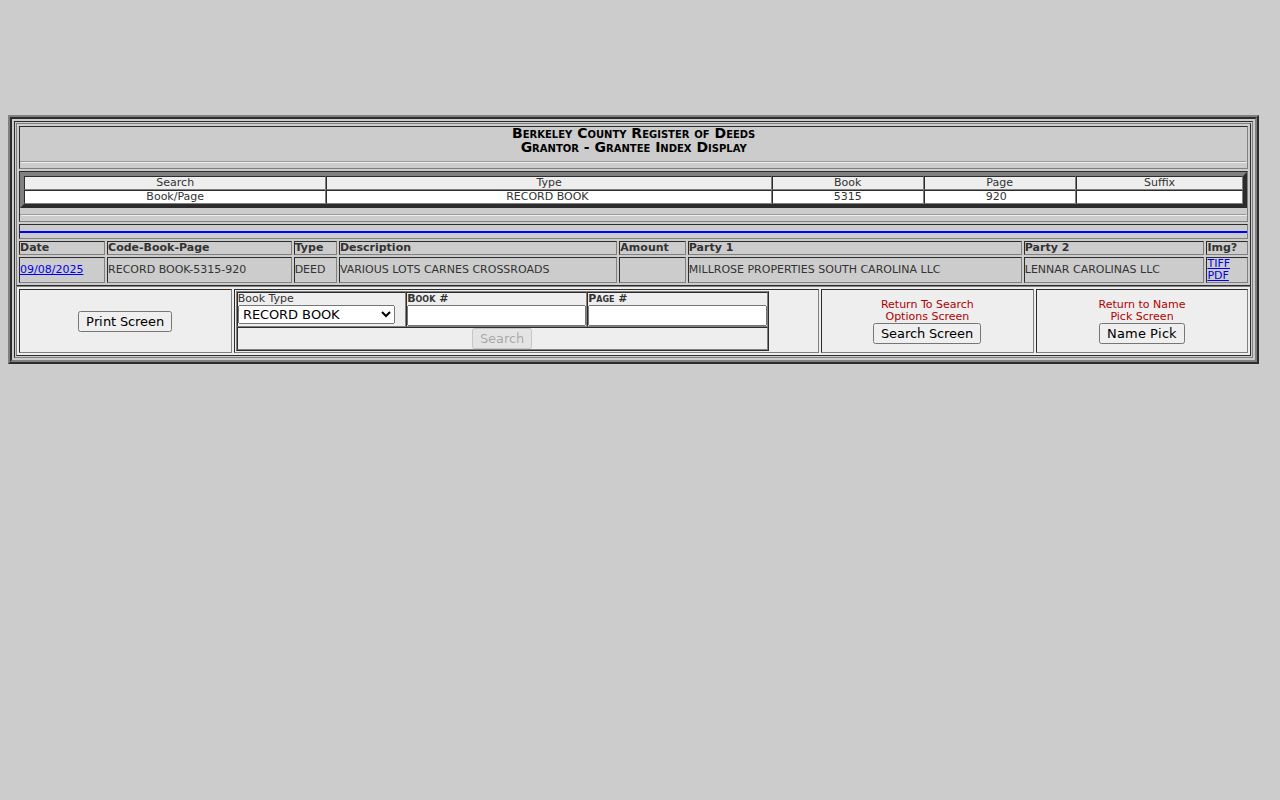
The index display includes Date, Code-Book-Page, Type, Description, Amount, Party 1, Party 2, and an image indicator. Those fields identify a recorded document and parties to it, not a current household roster.
Trace Goose Creek Previous Residents Through Deeds
Use a property card to locate the current or prior sale and its deed book/page. Open the purchase deed in the Berkeley ROD index, then note the seller, the legal description, the subdivision, and any prior book/page reference. Search that seller as a grantee to locate the earlier purchase, then repeat. The ROD offers grantor and grantee fields, date controls, document types, book/page or file-number fields, and property-description fields. Its option to search either party can help when the position changes, but each hit still needs document and property comparison.
- Search the Berkeley property card by street number and street name, or enter the TMS if it is known.
- Save the site address, current and previous sale details, legal description, parent TMS, plat reference, and deed book/page.
- Use the ROD’s book/page search or party search to find the purchase instrument for the parcel.
- Read the grantor, or seller, and search that person as a grantee on the earlier instrument.
- Repeat only when the legal description, lot/block, plat, or parent-parcel relationship matches the same property.
For a copy or a record beyond the web index, the ROD accepts a request with book/page, owner, TMS, physical address, or property description by email, phone at 843-719-4084, or its counter at 1003 Highway 52, Moncks Corner. Published counter hours are weekdays from 9 to 5.
- Grantor and grantee
- The grantor transfers an interest in a recorded document. The grantee receives that interest. Their names are roles in one transaction, not residence findings.
- Chain of title
- The documented sequence of transfers for one parcel. It must follow the same land description, not simply the same surname.
- Legal description
- The lot, block, subdivision, map, phase, unit, or other recorded parcel description used to identify land when a street label changes.
- TMS
- Berkeley’s tax-map identifier. It links the county property card, map, and many land-record references.
Goose Creek Previous Residents Need a TMS
A street number is a useful entry point, but it may not be the durable historical key. Berkeley cards separate owner mailing information from physical site addresses and also show parent TMS, lot/block/section, plat, and deed references. A parcel may be split, combined, or described by subdivision terms before a current street label appears. In those cases, follow the parent parcel, plat, and legal description rather than assuming that an old document uses the same address. This is especially important for previous residents research across a development change.
The property card’s owner field is also not a list of everyone who lived at the site. It identifies the assessed owner and parcel information. A mailing address can differ from the physical location, and an owner-occupied flag is an assessor category rather than a census of the household.
Tax Duplicates for Goose Creek Past Residents
Tax duplicates are a useful bridge when a deed transfer does not occur every year. SCDAH’s Berkeley guide lists Auditor tax duplicate books from 1884 through 1986. They offer year-to-year taxable-property evidence, not a direct occupancy record. Pair the tax entry with the parcel description, a conveyance date, and the name format used in the book. When a property changed shape or name, the legal description and plat can prevent a mistaken link between two similar addresses.
Berkeley County Auditor information explains the current county office’s tax-bill role and serves as the current administrative channel for tax questions.
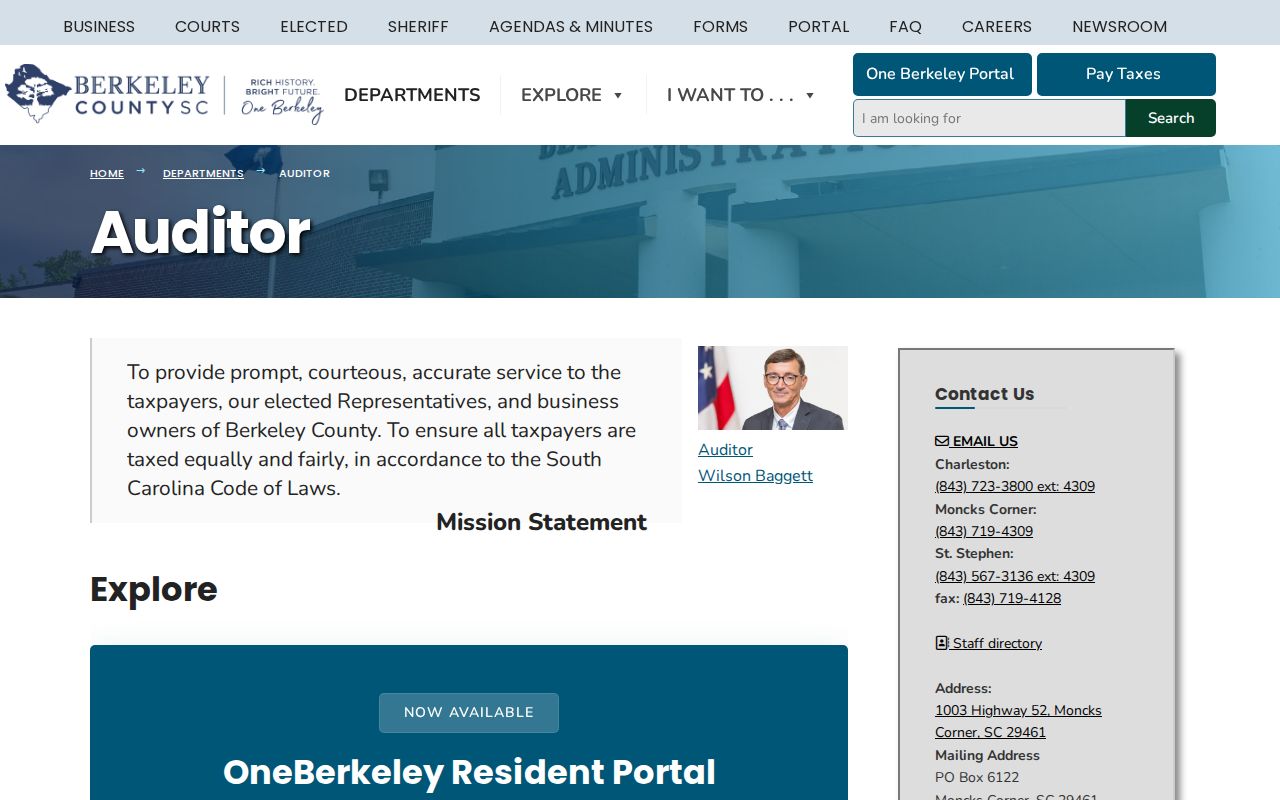
The live county tax system and historic duplicate books have different coverage. Use the current office for present tax administration and the archive guide for the older annual books.
Goose Creek Previous Residents at the Archive
At the archive stage, choose a record series by date and question. SCDAH lists conveyance books, tax duplicates, voter books, probate estate papers, marriage registers, a register of aliens, motor-vehicle records, and other Berkeley series. Estate papers can add relationship context. Berkeley Probate’s estate-opening process requires heir or devisee names and contact details, yet access to a particular record still depends on the custodian’s rules. A current vital record has its own statutory limits and is not a general historical-name directory.
Berkeley County Probate Court is the county route for estates and Berkeley marriage licenses, while older estate-paper coverage is identified in the SCDAH guide.
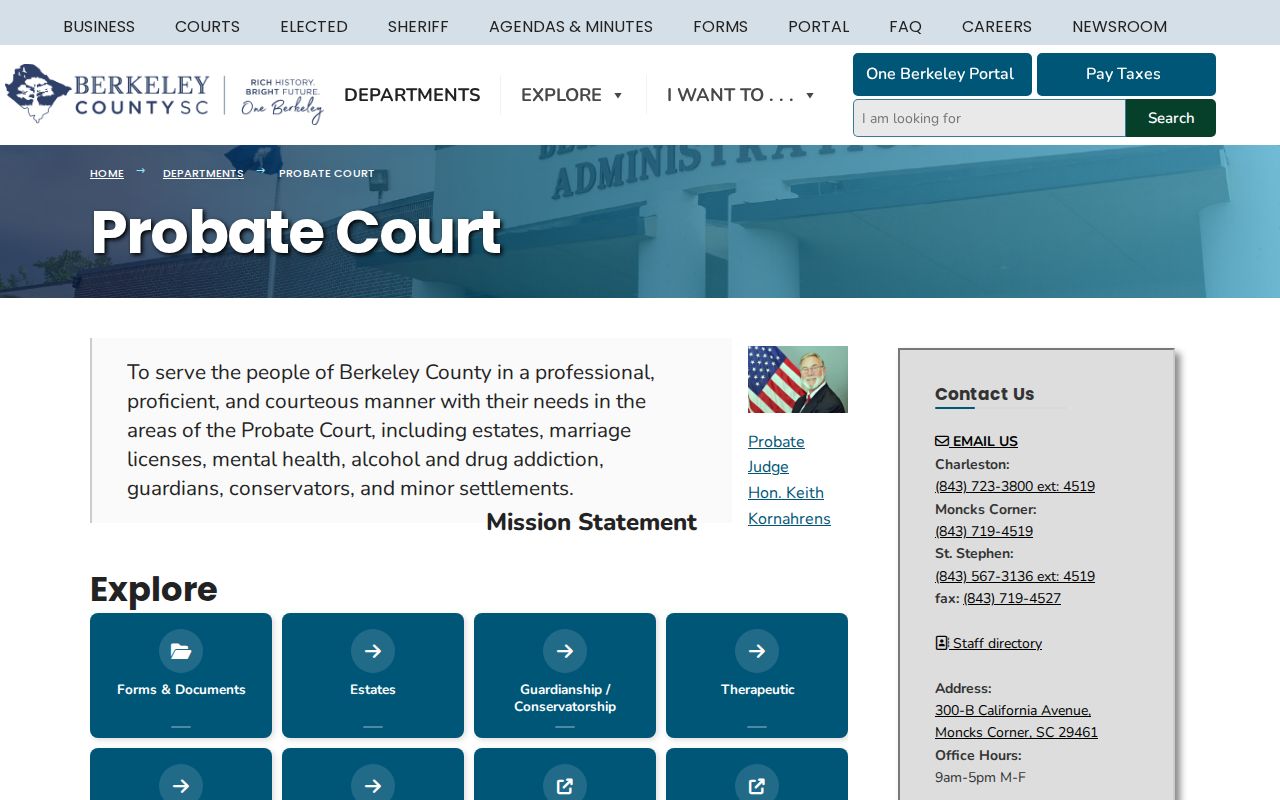
Probate material can help distinguish a deceased former owner from another person with the same name. It should be compared with a deed, date, and documented relationship rather than used alone.
SCDAH’s electronic-records preservation information provides the archival electronic-records route that complements its Research Room and county guide.
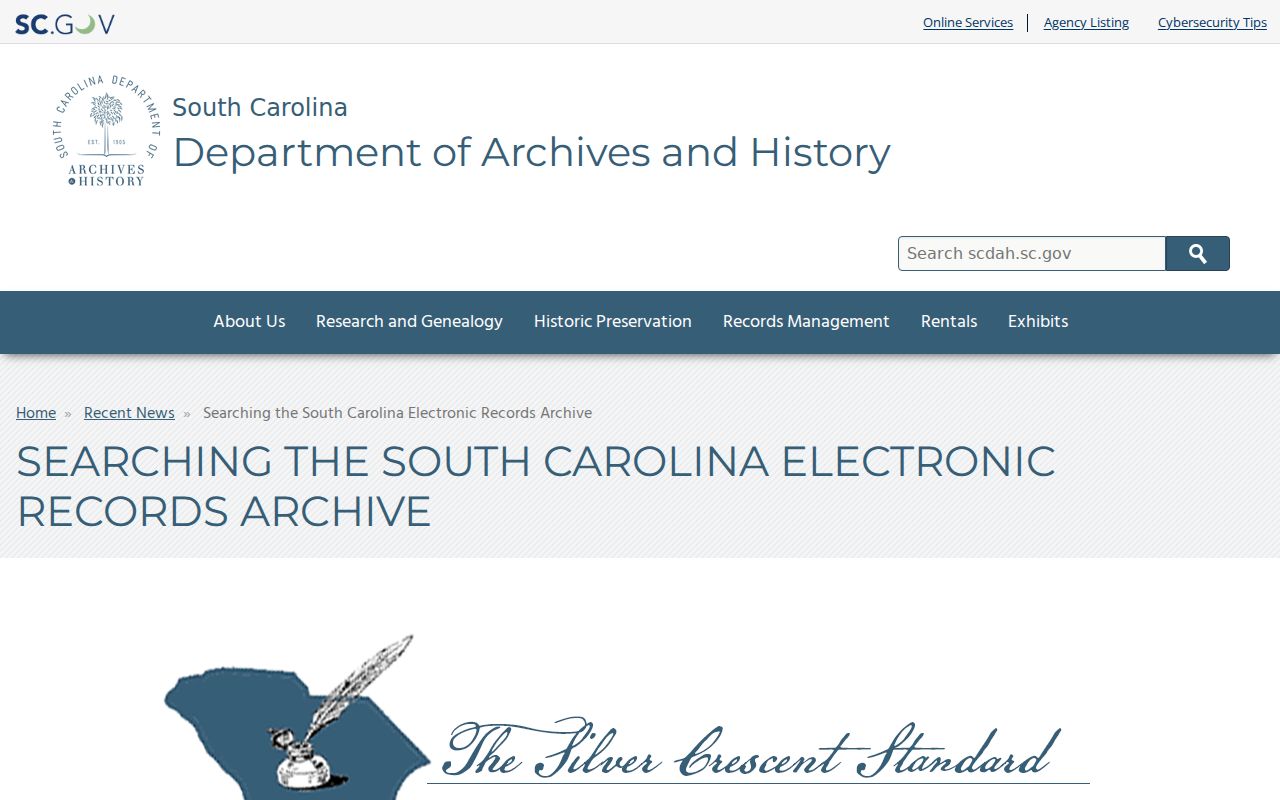
The online archive route does not replace a series-level request. For an older record, identify the Berkeley series, dates, and item details before contacting the repository. SCDAH’s published Research Room channel is 8301 Parklane Road, Columbia, SC, 803-896-6104, with catalog, online-index, and request-form routes for advance research.
Past Households in Goose Creek Records
Ownership is only one layer of a house history. The South Carolina Room lists federal census resources from 1790 through 1900 and selected specialized schedules for 1860, 1870, and 1880. It also holds local newspapers on microfilm, a death-certificate index guide, family-published cemetery records, local-history collections, church material, and the digitized 1956 Moncks Corner Community Directory. The latter is a specific regional item, not proof of a published Goose Creek directory run or address-order collection.
- Use the legal description and transfer date to define the parcel period to investigate.
- Check the 1956 community directory only if the place and time make it relevant.
- Pair a directory year with the closest released census year, noting that the census does not supply a same-year address listing.
- Use catalog-identified newspaper, church, WPA, or local-history material for a dated community connection.
- Compare the household evidence with the deed and tax trail before assigning it to the parcel.
The documented collections themselves are described in the Goose Creek city directory collections. A name that appears in a newspaper or census still needs a place and date match before it is connected to a particular house.
Limits on Goose Creek Previous Residents
Historic aerials from the county GIS begin in 1995 and continue through listed years ending in 2023. They can help date visible development change, but they do not identify residents or ownership by themselves. Goose Creek’s Building Permits route posts monthly issued-permit reports and directs current applications to its electronic portal. For an older address-specific file, use the permit office or City Clerk FOIA route rather than claiming an anonymous historic-person search exists. No authoritative source located a citywide Goose Creek street-renumbering year, a full historic Goose Creek city-directory run, or a general house-history guide. Preserve those gaps instead of filling them with assumptions.
Lawful use. Use Goose Creek address history for family history, estate matters, property research, or personal curiosity; never use records to harass, stalk, threaten, or harm another person.
Note: When records disagree, retain the TMS, legal description, date, and source citation, then confirm the point with the office that holds the original record.